The Cost of SEO vs. The Cost of Doing Nothing

You Asked

SEO can cost thousands of dollars a month. How do I know whether it’s actually worth the investment?

We Answer

Start by looking at what not investing could be costing you.

SEO has an obvious cost. You agree to a monthly retainer, an invoice arrives, and you can see exactly what you are spending.

The cost of not doing SEO is much harder to see. There is no invoice when a potential customer searches for your service and chooses the competitor above you. There is no notification when ChatGPT recommends three businesses and yours isn’t one of them. And you don’t get a monthly report showing the value of all the enquiries you never received.

But those missed opportunities have a value, which is why we think businesses need to look at SEO differently.

Instead of only asking, “How much does SEO cost?”, it may be more useful to ask: “What could better search visibility be worth to my business?”

This guide looks at the other side of the SEO equation: the potential cost of doing nothing.

The Cost of SEO Is Easy to Calculate

SEO pricing in New Zealand varies considerably depending on the market, competition and work required.

For established NZ businesses competing in meaningful search markets, ongoing SEO commonly requires an investment of around $1,500 to $3,500 per month, while more competitive national and ecommerce strategies can run considerably higher.

That investment pays for the work required to improve and maintain your visibility: technical SEO, content, on-page optimisation, authority building, search-intent analysis, reporting and, increasingly, optimisation for AI-driven search.

The number is right there on the invoice.

But whether $2,000 or $3,000 per month is expensive depends entirely on what a customer is worth to your business.

Start With Customer Value, Not SEO Cost

Imagine your average new customer generates $5,000 in revenue. If an SEO strategy eventually contributes just two additional customers per month, that represents $10,000 in additional monthly revenue, or $120,000 over the course of a year.

And that’s before considering repeat business, referrals, or the lifetime value of those customers.

Of course, change the numbers and the equation changes. A professional services business where a new client is worth $20,000 may only need a small number of additional customers for SEO to make commercial sense. An ecommerce business with a $70 average order value, on the other hand, will need significantly more sales to generate the same return.

That’s why asking what SEO “should cost” without first understanding the value of a new customer only tells half the story.

What Does Doing Nothing Actually Cost?

This is where the cost becomes less visible. Imagine 500 people search every month for services directly related to what your business provides. Your competitors occupy the strongest positions because they have useful service pages, established authority and content that answers the questions potential customers are asking. Meanwhile, your website sits on page two.

Those 500 searches still happen. You just aren’t getting your share of them.

Over a single month, that might not feel particularly significant. But over one, two or three years, the effect compounds. Your competitors aren’t simply collecting more clicks; they’re attracting more enquiries, building greater authority, creating more content and strengthening the very signals that make them harder to displace in the future.

The cost of doing nothing, then, isn’t simply standing still. It can mean falling further behind. 

Ranking Is Only Valuable if You Reach the Right People

More traffic isn’t automatically a sign of better SEO. Ausmove is a good example. The business already had significant search visibility, but much of that visibility was attracting people researching the idea of moving to Australia rather than people actively looking for a company to help them move.

The challenge, therefore, wasn’t simply to generate more traffic. It was to shift that visibility towards searches with stronger commercial intent. We restructured how Google understood the website, strengthened the relevance of key service pages and focused the strategy on reaching people as they progressed from researching a move to actually booking one.

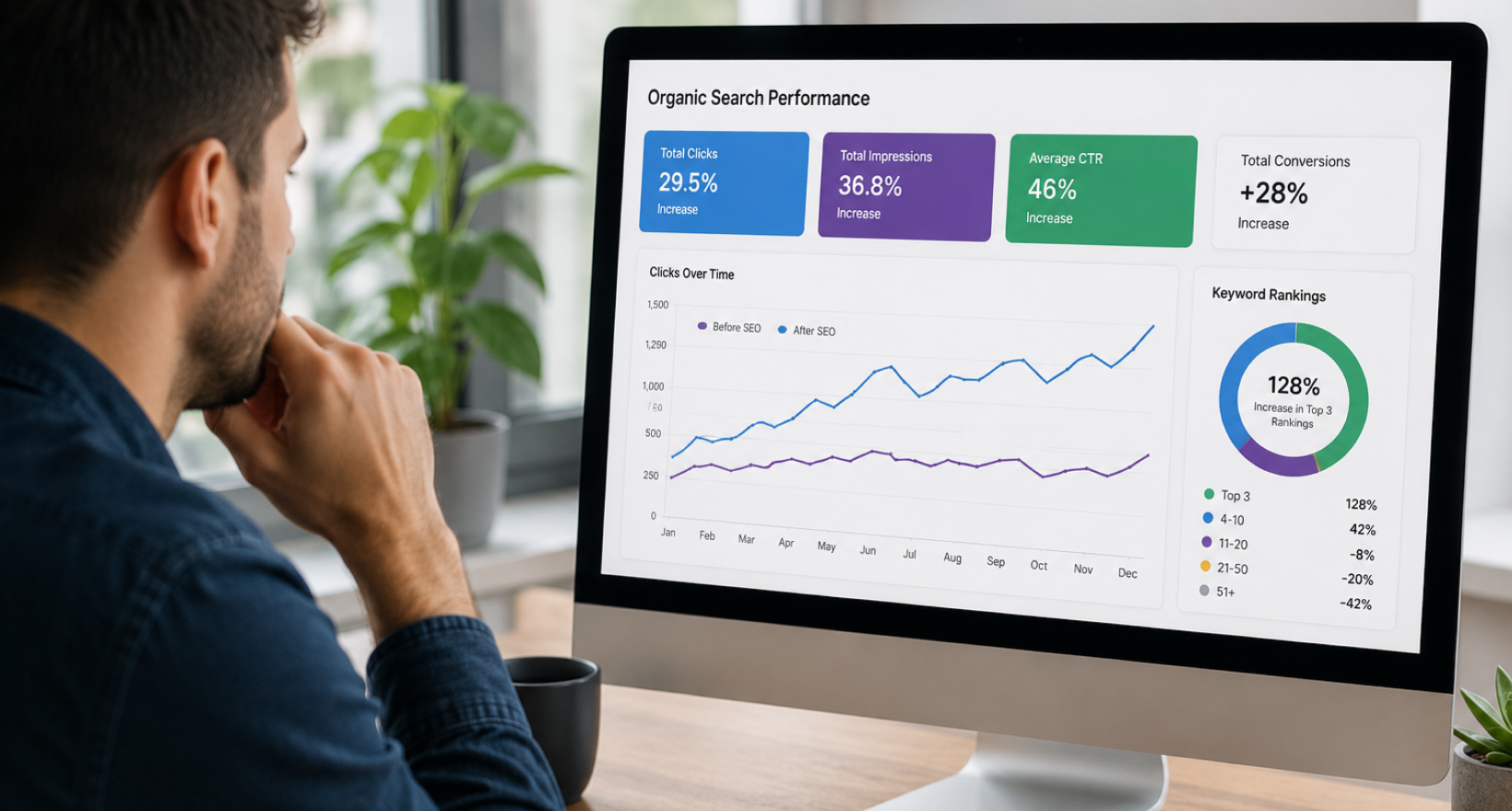
The results included a 46% improvement in click-through rate, 29.5% growth in organic clicks and 36.8% growth in unique queries.

The lesson is important: SEO isn’t about being visible everywhere. It’s about being visible when there is a commercial opportunity.

What if Your Business Is Barely Visible?

Master Machinery started from the opposite position. The company had strong products and genuine industry expertise, but its new website had almost no organic search presence. In June 2025, the website generated just 33 monthly organic clicks and 565 impressions, with an average search position of 28.99.

The products weren’t the problem. Discoverability was.

We built the SEO foundations around how customers actually search for machinery, from identifying a problem and comparing potential solutions through to high-intent searches when they’re ready to buy.

By June 2026, monthly organic clicks had increased to 672, while monthly impressions had grown to 8,400. The website’s average search position improved from 28.99 to 2.8, with 472 search terms ranking in Google’s top 10.

That’s what the cost of poor visibility can hide. There can be genuine demand for what you sell, but if your business isn’t appearing when potential customers search, your website may be capturing only a fraction of it.

Your Competitors Don’t Need to Be Better Than You

Sometimes, your competitors don’t need to have a better product, more experience or a more compelling service. They just need to be easier to find.

If Google consistently puts them in front of potential customers first, they get the opportunity to make their case before you do. Over time, that visibility can translate into more enquiries, more sales and a stronger position in the market.

That’s what makes search visibility a commercial issue, rather than simply a marketing metric. Rankings, impressions and clicks matter, but ultimately they matter because of what sits behind them: potential customers.

And Now There Is Another Search Engine to Think About

The search landscape is also changing.

Your customers aren’t exclusively typing searches into Google anymore.

They’re asking ChatGPT, Gemini and other AI-powered platforms questions such as:

• Who are the best providers in my area?
• Which company specialises in this?
• What should I look for when choosing a provider?
• What are the best options in New Zealand?
• Who would you recommend?

This changes what search visibility means.

Traditional SEO remains important, but businesses increasingly need to consider whether AI systems can understand who they are, what they specialise in, and why they should be surfaced as a relevant answer.

That means strong technical foundations, clear entities, useful content, authority and structured information matter beyond Google’s traditional search results.

Being invisible in search increasingly means being invisible across both Google and AI discovery.

SEO Is a Compounding Investment

Paid advertising largely stops producing traffic when you stop paying for the clicks.

SEO works differently.

A service page improved today can continue ranking next month. A useful article can attract potential customers for years. Technical improvements benefit every page built on top of them. Authority earned over time makes future content easier to rank.

That doesn’t mean SEO produces permanent results without ongoing work. Competitors move, search behaviour changes and algorithms evolve.

But it does mean SEO can create an asset that compounds.

And that creates another hidden cost to delaying it:

the growth you could have been building during that time.

So, Is SEO Worth the Cost?

There isn’t one answer for every business.

If there is little search demand for what you sell, your margins are extremely low, or customers simply don’t use search when choosing a provider, SEO may not deserve a significant share of your marketing budget.

But if your customers are actively searching for what you provide, the calculation becomes much more interesting.

Ask yourself:
• What is an average new customer worth?
• How many relevant searches happen in our market?
• Where do we currently appear?
• Who is capturing the searches above us?
• How many additional customers would SEO need to generate to cover its cost?
• Are we visible when people ask AI platforms about our category?
• Those questions put the investment into a commercial context.

Frequently Asked Questions

How much does SEO cost in New Zealand?

For established NZ businesses, ongoing SEO commonly ranges from around $1,500 to $3,500 per month, with highly competitive, national and ecommerce campaigns often requiring $3,500 to $8,000+ per month. The right investment depends on your competition, current visibility and commercial opportunity.

How long does SEO take to work?

SEO should be treated as a medium-to-long-term growth strategy rather than an instant lead-generation channel. How quickly results appear depends heavily on your starting position, competition and the amount of work required.

Is SEO still worth investing in with AI search?

Yes, but the definition of SEO is expanding. Businesses now need to consider visibility across traditional Google results, AI-powered Google experiences and platforms such as ChatGPT and Gemini. The underlying objective remains the same: make your business easy to understand, trust, find and recommend.

How can I tell if SEO will be profitable for my business?

Start with your customer economics. Work out what a new customer is worth, how many additional customers would cover your SEO investment, and whether sufficient search demand exists to make that achievable.

Find Out What You’re Currently Missing

The easiest number to see is what SEO costs.

The harder number is what being invisible is already costing you.

NZ Digital’s SEO Visibility Report looks at your current Google and AI search visibility, how you compare against competitors, where the gaps are and where the strongest opportunities for growth exist.

Rather than guessing whether SEO is worth investing in, we can look at the actual search opportunity around your business.

Find out where you’re visible, where you’re not, and what that opportunity could be worth.

Get your SEO Visibility Report

About NZ Digital

NZ Digital are a Auckland based digital marketing agency, we offer a wide range of done for you digital marketing and lead generation services. If you have more questions or would like to book a FREE Digital Marketing consult please schedule a call with us.

About the agency

Insights from the digital experts

How Much Does a Website Cost in NZ? A Realistic 2026 Pricing Guide
Adam Harris
Adam Harris
Aug 10th, 2026
How Much Does a Website Cost in NZ? A Realistic 2026 Pricing Guide
Aug 10th, 2026

If you have asked three different web companies for a quote, you have probably received three wildly different numbers.

Read More
Is Shopify Plus Worth It for NZ Businesses? An Honest Guide
Adam Harris
Adam Harris
Aug 5th, 2026
Is Shopify Plus Worth It for NZ Businesses? An Honest Guide
Aug 5th, 2026

Shopify Plus is Shopify's enterprise tier, and it occupies an odd place in most NZ retailers' minds.

Read More
What Is an SEO Audit and Does Your NZ Website Actually Need One?
Adam Harris
Adam Harris
Jul 25th, 2026
What Is an SEO Audit and Does Your NZ Website Actually Need One?
Jul 25th, 2026

SEO pricing in New Zealand is genuinely confusing, and the confusion is not an accident.

Read More
View All