Performance Max for New Zealand Businesses: When It Works and When It Doesn’t

You Asked

Google keeps pushing us to run Performance Max, and when we do it takes over most of our budget. Is it actually working for us, or is it just spending our money wherever Google wants to?

We Answer

Both can be true at once. Performance Max is genuinely powerful for the right business with the right data feeding it, and a quiet budget drain for the wrong one. The difference comes down to your goals, the quality of your conversion tracking, and the signals you give it.

Performance Max, usually shortened to PMax, is Google’s flagship automated campaign type, and Google recommends it to almost everyone. That enthusiasm is understandable, because when it works it works very well, but it also means plenty of NZ businesses are running it without ever deciding whether it suits them. The core trade-off is control. You hand a large amount of decision-making to Google’s AI, and in return you get reach and efficiency you would struggle to manage by hand. For some businesses that is a brilliant deal. For others it is a way to spend money in places you cannot see.

We run Google Ads for New Zealand businesses on both sides of that line, so this guide gives you the honest version: what Performance Max actually is, when it earns its budget, when a simpler approach wins, and how to run it well if you do.

What Is Performance Max?

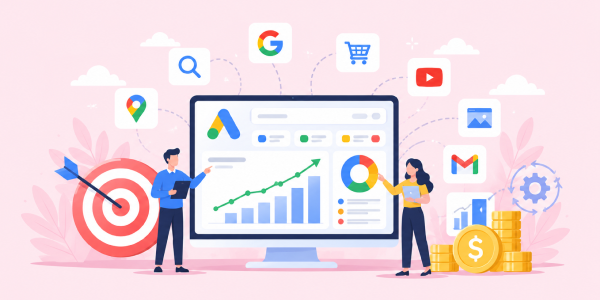
Performance Max is a goal-based campaign type that lets you reach all of Google’s advertising inventory from a single campaign. According to Google’s own description, one PMax campaign can serve across Search, Shopping, YouTube, Display, Discover, Gmail and Maps at the same time. Rather than building and managing a separate campaign for each of those channels, you set a conversion goal, upload your creative assets, and provide audience signals, and Google’s AI decides which combination of channel, audience, creative and bid to use for each individual auction.

The engine underneath is Smart Bidding, working towards a target you choose, such as a target cost per action, a target return on ad spend, or simply maximising conversions or conversion value. Google states that advertisers using Performance Max see an average of eighteen percent more conversions at a similar cost per action, though as with any vendor figure, your own results depend heavily on how well you set it up.

What You Hand Over, and What You Keep

It helps to be precise about the trade. When you run Performance Max, you hand Google the channel mix, the placements, the per-auction bidding and the decision about which creative shows where. What you keep is more than people assume: your conversion goals, your budget, the quality of your creative assets, your audience signals, your brand exclusions, and, more recently, negative keywords. In other words, you are not powerless inside PMax. You are steering rather than driving, and the businesses that succeed with it are the ones that steer deliberately.

When Performance Max Works Well for NZ Businesses

Certain conditions make Performance Max shine, and most of them come back to one idea: the AI is only as good as the data and assets you feed it.

You run ecommerce with a solid product feed

This is PMax at its strongest. With a well-structured product feed, it can dominate Google Shopping while filling in Search, YouTube and Display around it, which is why it has become the default for many online stores. If you sell online, it pairs naturally with a well-built Shopify website, and a clean feed does much of the heavy lifting. Our guide to Google Merchant ads covers the feed side in detail.

Your conversion tracking is accurate and has volume

Performance Max learns from your conversion data, so if that data is thin or unreliable, it optimises towards the wrong thing. Businesses with clean tracking and a healthy number of monthly conversions give the AI enough signal to make good decisions. If you are not confident your tracking is solid, that is the first thing to fix, and our analytics and insights work exists precisely for this.

You have a clear commercial goal and good creative

PMax rewards businesses that can tell it exactly what a valuable outcome is worth, which makes value-based bidding powerful when you have the data for it. It also rewards strong, varied creative, because in 2026 the targeting is largely automated and the creative itself has become the main lever you control. Good images, clear headlines and at least some video give the system room to find what works.

When a Simpler Approach Wins

Just as often, Performance Max is the wrong first move, and honesty here saves real money.

Your conversion data is thin

If you generate only a handful of conversions a month, the AI does not have enough to learn from, and a well-managed Search campaign will usually outperform it. Automation needs fuel, and low-volume accounts rarely provide enough.

You do lead generation with variable lead quality

PMax optimises towards whatever you tell it counts as a conversion. If every form fill looks identical to the system, it will happily generate cheap, low-quality leads. This is fixable by importing offline conversion data so the system learns which leads actually became customers, but without that feedback loop, lead-gen accounts can drift towards volume over value.

Your budget is very small, or your brand is the prize

The learning phase consumes budget before it delivers, so very small budgets struggle to escape it. Separately, because PMax can serve on Search, it will happily appear against your own brand name and claim those cheap conversions as its own, flattering its numbers while cannibalising traffic your organic listings or a dedicated brand campaign would have won for far less. Setting brand exclusions is essential, and if your ads generally feel like they are underdelivering, our article on why Google Ads stops working covers the common culprits.

How to Run Performance Max Well in 2026

If Performance Max does suit you, a handful of disciplines separate the accounts that thrive from the ones that leak money.

Start with clean conversion tracking and, wherever possible, feed the system the value of each conversion rather than just the count, so it can optimise towards revenue instead of raw volume. Our explainer on return on ad spend is worth reading before you set targets. Set brand exclusions early to stop the campaign cannibalising your brand searches, and build a negative keyword list, which PMax now supports, to keep it away from irrelevant queries.

Treat creative as the lever it now is, giving the system strong, varied assets and refreshing the ones that underperform. Use audience signals built from your own first-party data to point the AI in the right direction from the start. Take advantage of the channel-level reporting Google rolled out in 2026, which finally shows how spend splits across Search, YouTube, Display and the rest, so you can stop guessing. And make sure the traffic lands somewhere that converts, because the fastest way to waste a good campaign is to send it to a weak page. Our work on conversion rate optimisation is often where the real gains hide.

Performance Max Is a Tool, Not a Strategy

The biggest mistake we see is treating Performance Max as the whole plan. It is one campaign type among several, and it works best inside a considered mix: Search campaigns capturing high-intent demand, remarketing bringing back people who already know you, and organic search reducing how much you need to pay for clicks at all. If you want to understand how the pieces fit, our comparison of paid ads versus SEO and our guide to remarketing both help. And whatever you run, judge it on real return, not on the numbers Google reports inside the platform, which our guide to working out digital marketing ROI walks through.

Frequently Asked Questions

Does Performance Max replace Search campaigns?

No. Google positions Performance Max as a complement to keyword-based Search campaigns, not a replacement. Most well-run NZ accounts use both, with Search capturing high-intent demand and PMax finding additional converting customers across Google’s other channels.

How much budget does Performance Max need in NZ?

There is no fixed figure, but the campaign needs enough spend to move through its learning phase and gather conversion data, so very small daily budgets tend to struggle. As a rule of thumb, if you cannot fund a meaningful number of conversions a month, a focused Search campaign is often the better starting point.

Why is Performance Max spending on my brand searches?

Because PMax can serve on Search, it will appear against your own brand terms and claim those low-cost conversions unless you stop it. Setting brand exclusions keeps it away from your brand searches so it focuses on genuinely new demand.

Is Performance Max good for lead generation?

It can be, but only if you feed it quality signals. Importing offline conversion data, so the system learns which leads became real customers, is what stops it from optimising towards a high volume of low-value enquiries.

Let’s Make Your Google Ads Work Harder

NZ Digital plans and manages Google Ads for businesses across New Zealand, including Performance Max, Search and Shopping. We can look at your account, your goals and your tracking, and give you a straight answer on whether PMax is helping or quietly costing you, and how to structure your spend so every dollar is accountable.

If your budget is disappearing into a campaign you cannot see inside, visit our contact page and let’s take a proper look together.

About NZ Digital

NZ Digital is an Auckland-based digital marketing agency specialising in lead generation, paid advertising, SEO, and digital strategy. If you’d like help understanding your performance or improving your results, get in touch for a strategy session.

About the agency

Insights from the digital experts

Web Design ROI: How to Work Out the Return on a Website Rebuild
Emma Lum
Sep 25th, 2026
Web Design ROI: How to Work Out the Return on a Website Rebuild
Sep 25th, 2026

SEO is one of the most important long-term investments in digital marketing, but choosing the right agency can be difficult when so many promise the same results. The difference often comes down to transparency, strategy and the questions you ask before signing.

Read More
How to Choose an SEO Agency in Auckland: 10 Questions to Ask First
Emma Lum
Sep 3rd, 2026
How to Choose an SEO Agency in Auckland: 10 Questions to Ask First
Sep 3rd, 2026

SEO is one of the most important long-term investments in digital marketing, but choosing the right agency can be difficult when so many promise the same results. The difference often comes down to transparency, strategy and the questions you ask before signing.

Read More
The Cost of SEO vs. The Cost of Doing Nothing
Adam Harris
Adam Harris
Aug 25th, 2026
The Cost of SEO vs. The Cost of Doing Nothing
Aug 25th, 2026

SEO has a clear price tag,but the real cost may be the customers, visibility and long-term growth your business is missing by doing nothing.

Read More
View All