
When Your AI Screws Up, Who Owns It?
Oct 19th, 2026When AI makes a mistake, who's responsible? Learn about AI accountability, business risks and how NZ companies can use AI responsibly.
Read More
You Asked
We Answer
There has been a real shift in the AI conversation over the past twelve months. Two years ago the question was whether AI would deliver business value. In 2026, the data has settled that question. According to research by 2degrees and Deloitte Access Economics, the average New Zealand SME using AI earned around $400,000 more in FY25 than a comparable non-adopter.
The new question is what AI actually does well, where it earns its keep, and where it still falls short. For NZ business owners trying to work out where to focus, that distinction is the entire game.
Quick Links
The picture has changed quickly. Commvault’s State of Data Resilience report found that more than 30 per cent of New Zealand organisations are already trialling or deploying agentic AI across IT, cybersecurity, and business operations in 2026, with nearly all surveyed organisations expecting AI investment to increase this year. Across the wider business base, AI now accounts for 29 per cent of technology spending, and that share is expected to climb to 34 per cent over the next two years.
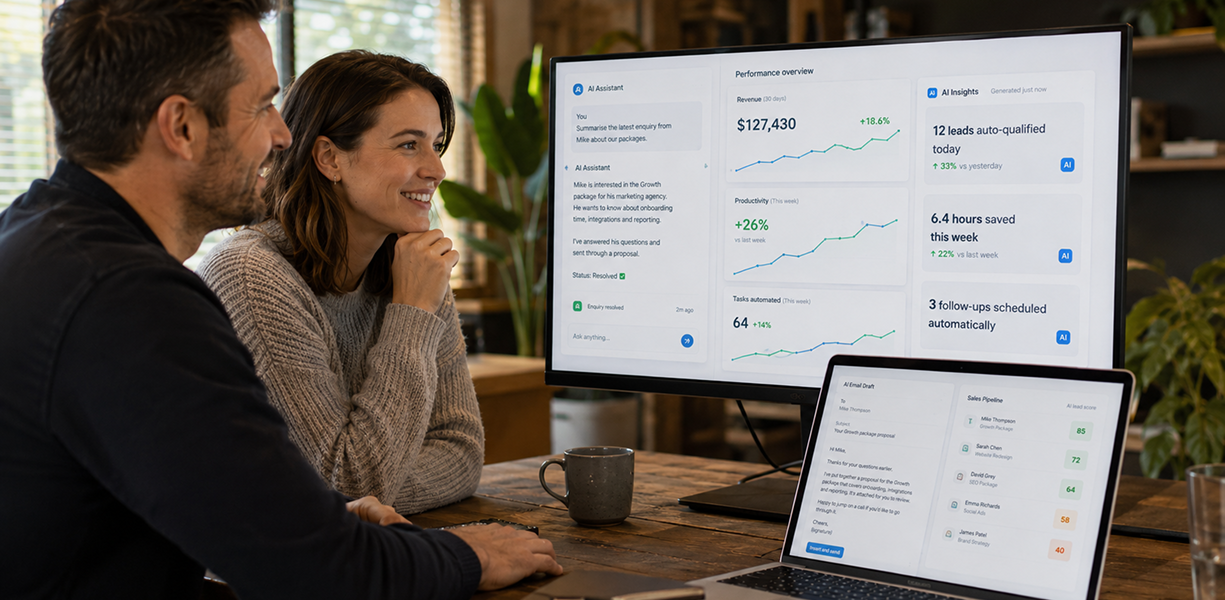
The interesting part is what those businesses are actually getting back. Stanford’s 2026 AI Index found AI is delivering measurable productivity gains of around 14 per cent in customer service and 26 per cent in software development. A Bain Agentic AI Benchmark estimate puts the average knowledge-worker saving at roughly 6.4 hours per week. That is not a trivial number. For a team of ten, it is the equivalent of an extra full-time staff member’s productivity, every week, with no additional headcount.
The gap between the businesses getting those results and the ones still experimenting is widening. PwC’s research on New Zealand private and family businesses described it as a separation between organisations that are genuinely redesigning how work gets done, and those that are treating AI as another tool to bolt on. The first group is pulling ahead. The second is busy.
The honest answer to “what can AI do for my business” is that the gains are concentrated in a small number of specific places. Knowing where they are is most of the work.
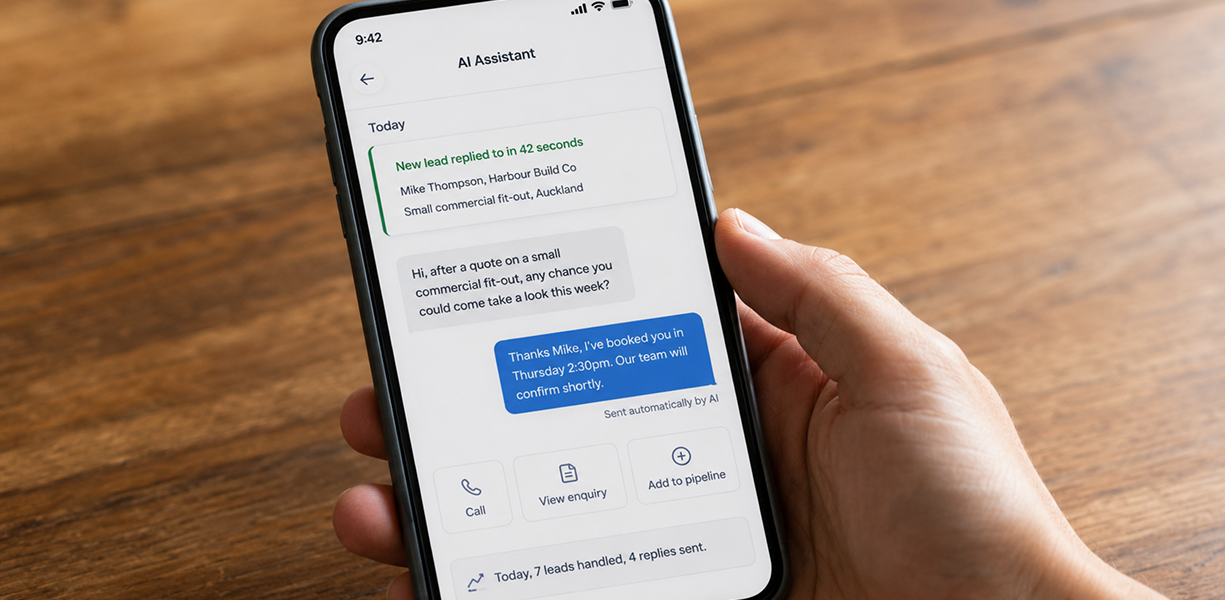
This is the highest-ROI application for most NZ businesses we see, and it is almost never the first thing people think of. The reality is that most leads go cold within minutes, not days. AI is now reliably handling that first response in seconds, qualifying the enquiry, and routing the warm ones to your team while they are still hot.
A business responding in four minutes instead of two days is closing deals that competitors never even knew they had a chance at. That is the entire commercial argument, and it is the single biggest gap we see when we look inside NZ businesses.
Customer service is where AI productivity gains are most reliably documented, with industry research consistently putting the return at around $3.50 for every dollar spent. The mechanics are simple. AI handles the repetitive enquiries, your team handles the complex ones, and customers get faster answers either way.
For NZ businesses with any meaningful support workload, this is straightforward territory. The investment pays for itself quickly, and the customer experience improves alongside the cost savings rather than instead of it.
This is the unglamorous one, and often the biggest single saving. Manual data entry, invoice processing, internal reporting, scheduling, repetitive email drafting. Each one of these is a candidate for automation, and most NZ businesses have dozens of them.
Half an hour back per person per day is the kind of figure that sounds small until you multiply it across a team and over a year. It is real hours and real dollars, and it adds up faster than most businesses realise.
Sales teams using AI well are pulling ahead noticeably on revenue growth. The gains come from AI doing the things human salespeople either cannot do or will not do reliably: scoring every lead, drafting personalised follow-ups at scale, and surfacing the deals most likely to close this week. None of that replaces a good salesperson. It removes the admin and pattern-matching that usually slows them down.
The optimistic case for AI is strong, but it is not unlimited. Knowing where AI falls down is just as commercially important as knowing where it shines.
AI is not reliable for tasks requiring genuine judgment. The productivity gains being measured in customer service and software development do not show up in work that requires nuance and weighing things up. Legal review, clinical work, strategic decisions, and anything involving complex tradeoffs are not areas where AI replaces expertise. It can assist, but the human still does the work.
AI still hallucinates. Generative AI models will confidently produce information that is wrong. For external-facing content, customer communications, or anything where accuracy matters commercially, human review remains essential. The businesses getting this right treat AI as a draft, not a deliverable.
AI does not understand your business unless you teach it. Out of the box, AI knows nothing about your customers, your pricing, your competitors, your internal processes, or your industry’s quirks. The businesses getting outsized results are the ones that have invested in connecting AI to their actual systems and data. Without that, AI is a generic tool producing generic output.
AI cannot do strategy. It can summarise options, model scenarios, and draft proposals. It cannot tell you what your business should focus on, what your customers actually want, or where your market is going. Those are still leadership decisions.
The most striking thing about New Zealand’s AI position right now is how much commercial value is still sitting on the table.
Research from the University of Auckland’s ALTeR centre, citing the Government’s AI Strategy, found 68 per cent of New Zealand SMEs have no plans to evaluate AI technology at all, compared to 38 per cent across the Tasman in Australia. That is a thirty-point gap on a technology already producing measurable revenue differences at every business size.
The barrier most often cited is not cost or risk. It is lack of expertise. NZ business owners know AI is doing something somewhere, but are not sure what it does in their business or where to start. The opportunity for the businesses moving first is significant. The risk for the ones waiting is becoming harder to ignore.
The businesses getting strong returns from AI are not the ones using the most tools. They are the ones using AI in the right places.
A useful starting point is to look at where time and money are actually leaking out of your business right now. Where is your lead follow-up slow? Where is your team spending hours on repetitive admin? Where are customer enquiries taking longer to resolve than they should? Each of those is a candidate for AI to do real work, and each one has a measurable dollar figure attached.
From what we see, the businesses getting strong returns share a handful of habits. They focus on a small number of high-impact workflows rather than experimenting broadly. They invest in capability, not just tools. They design for measurable outcomes from day one. And they treat AI as a strategic decision rather than a technology one.
The wrong question is “What AI tools should we buy?” The right question is “where in our business are we leaving margin on the table, and which of those problems does AI actually solve?” That is a much shorter list, and the answers are usually specific to the business.
NZ Digital works with New Zealand businesses to identify where AI can save time, lift margin, and reduce overhead across their existing systems and workflows. Our AI Opportunity Audit maps the highest-impact applications for your specific business, quantifies the opportunity in hours and dollars, and delivers a prioritised roadmap you can action.
If you are weighing up where AI fits in your business and want a clear answer instead of more options, the best starting point is a conversation. Visit our contact page and let’s talk about where the margin is in your business.
NZ Digital are a Auckland based digital marketing agency, we offer a wide range of done for you digital marketing and lead generation services. If you have more questions or would like to book a FREE Digital Marketing consult please schedule a call with us.
When AI makes a mistake, who's responsible? Learn about AI accountability, business risks and how NZ companies can use AI responsibly.
Read More
SEO is one of the most important long-term investments in digital marketing, but choosing the right agency can be difficult when so many promise the same results. The difference often comes down to transparency, strategy and the questions you ask before signing.
Read More
Performance Max gives businesses a way to reach customers across Google’s entire advertising network from one campaign, but its success depends heavily on strong tracking, enough conversion data and clear commercial goals.
Read More


