How Much Does SEO Cost in NZ? A Straight Answer for 2026
Jul 17th, 2026SEO pricing in New Zealand is genuinely confusing, and the confusion is not an accident.
Read More
You Asked
We Answer
Social media occupies a strange position in most NZ businesses’ marketing. Everyone feels they should be doing it, most are doing it half-heartedly, and very few can point to what it actually returns. The result is a familiar cycle: a burst of posting enthusiasm, three months of silence, a guilty restart.
The honest answer to whether social media marketing is worth it depends on what you expect it to do, which platforms you choose, and whether you resource it properly. This guide covers how the landscape actually looks for NZ businesses in 2026, where the returns genuinely come from, and how to decide where your effort belongs.
Quick Links
The first correction most businesses need to make is about the job social media performs. Organic social is rarely a direct lead-generation channel anymore. Organic reach for business pages has been declining for a decade, and on most platforms, only a small fraction of your followers see any given post.
What social media does exceptionally well is different: it keeps your brand present between purchase decisions, it provides social proof when prospects check you out (and they do check), and it feeds the rest of your marketing. A potential customer might discover you through Google, look you up on Instagram or Facebook to see whether you look real and current, and only then enquire. A dormant or abandoned profile quietly costs you those enquiries, which is a genuine trust signal problem rather than a reach problem.
Paid social is a separate discipline with a separate job: precise, measurable demand generation. Conflating the two is the single most common reason businesses conclude that “social media doesn’t work”.
Despite years of predicted decline, Facebook remains the largest social audience in New Zealand and the backbone of paid social for most local businesses. Its organic reach for pages is poor, but its advertising platform, community groups and Marketplace presence still matter, particularly for local services and audiences over 35. Our guide to everything you need to know about Facebook Ads covers the paid side in depth.
Instagram is where visually-led NZ businesses – hospitality, retail, property, fitness, beauty, food and drink – earn their keep. Reels remain the main organic reach mechanism, and the platform shares its advertising system with Facebook, so paid campaigns run across both from one account.
For NZ businesses selling to other businesses, LinkedIn is usually the highest-value platform, both organically through founder and team profiles and through targeted LinkedIn advertising. Personal profiles consistently outperform company pages for organic reach, which is covered in our guide to growing your LinkedIn presence.
TikTok offers the best organic reach of any major platform and a substantial NZ audience that now extends well beyond teenagers. The catch is appetite: it rewards a steady supply of native, personality-led video, which is a real production commitment. For brands targeting under-35s with the capacity to create, it is the biggest organic opportunity available. For everyone else, it is a distraction.
One platform done properly beats four done poorly, every time. Choose based on where your customers actually are and what you can sustain, not on where you feel you should be.

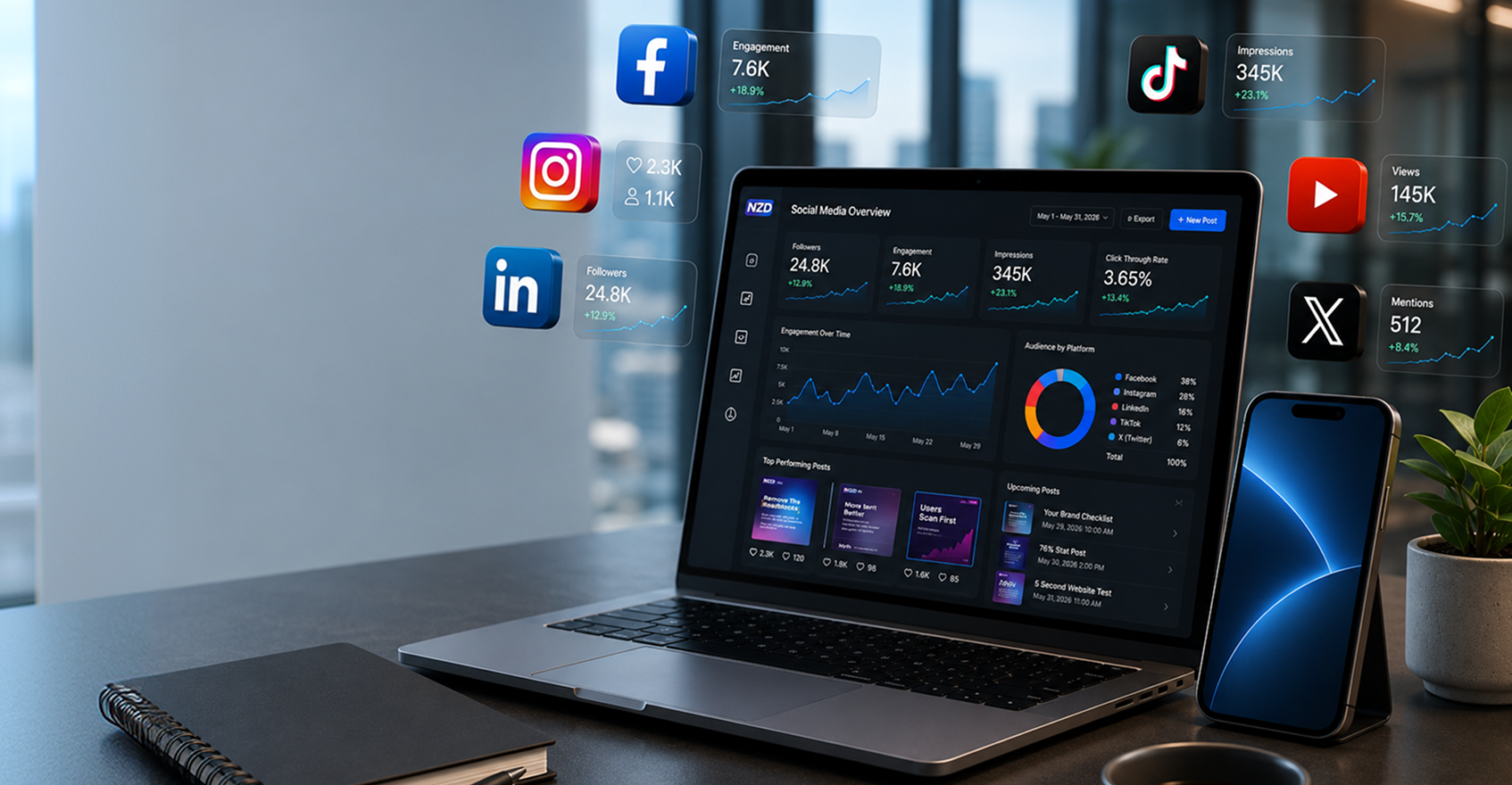
The most effective structure we see for NZ businesses combines a sustainable organic baseline with targeted paid amplification. Organic content maintains presence and proof: a realistic rhythm might be two to four quality posts a week on one or two platforms, built around your genuine expertise rather than generic motivational filler. Paid campaigns then do the commercial heavy lifting: reaching people who have never heard of you, and bringing back the ones who have through remarketing.
This split also fixes the measurement problem. Organic is measured on engagement, profile visits and direct enquiries. Paid is measured on cost per lead and return on spend, the same way you would evaluate Google Ads. Our article on working out digital marketing ROI walks through that calculation.
Done in-house, the main cost is time: a realistic organic presence takes several hours a week of planning, creating and responding, and the businesses that underestimate this are the ones whose feeds go quiet by March. Outsourced social media management in NZ typically ranges from around $1,000 to $3,500+ per month, depending on platforms, content volume and whether video production is included. Paid social budgets for SMEs commonly start around $500 to $2,000 per month in ad spend, scaling with ambition.
Whichever route you take, the biggest cost driver is creative. In 2026, targeting is largely automated across Meta and TikTok, which means the creative itself – the hook, the video, the offer – is what determines performance. Budget for content quality before budget for reach.
Posting without a point. Content that exists to fill a calendar rather than to demonstrate expertise, show work, or answer real customer questions builds nothing. As with content marketing generally, generic content has lost its value; content only your business could produce is what performs.
Chasing followers instead of customers. A small, local, engaged audience is worth more than a large, irrelevant one. Follower count is the vanity metric of the industry.
Boosting posts instead of running campaigns. The boost button is the most expensive way to buy Meta advertising. Proper campaigns with defined objectives, audiences and conversion tracking consistently outperform boosted posts.
Sending paid traffic to a weak website. Social ads can only deliver the click. If the landing page does not convert, the budget leaks – which is why we treat paid social and conversion rate optimisation as inseparable.
Social media works hardest when it is connected to everything else: it distributes your content, retargets your website visitors, nurtures your email list alongside email marketing, and keeps your brand warm while SEO and paid search capture active demand. In isolation, it is a megaphone; inside a digital strategy it is a multiplier. For an independent snapshot of how New Zealanders actually use these platforms, DataReportal’s annual Digital New Zealand report is a useful reference point.

NZ Digital provides social media and content marketing services for businesses across New Zealand, from strategy and content creation through to fully managed done-for-you digital marketing. We focus on the platforms that fit your customers, creative that reflects your actual expertise, and measurement that shows what it returns.
If your social media is absorbing effort without producing results, visit our contact page and let’s talk about where your effort actually belongs.
NZ Digital are a Auckland based digital marketing agency, we offer a wide range of done for you digital marketing and lead generation services. If you have more questions or would like to book a FREE Digital Marketing consult please schedule a call with us.