

The Cost of SEO vs. The Cost of Doing Nothing
Aug 25th, 2026SEO has a clear price tag,but the real cost may be the customers, visibility and long-term growth your business is missing by doing nothing.
Read More
You Asked
We Answer
ROAS (Return on Ad Spend) is one of the most commonly used metrics in digital marketing. It’s often the first number business owners ask about and the one most agencies report on.
But here’s the issue:
Most businesses focus on ROAS… without fully understanding what it actually means.
ROAS is calculated as:
Revenue ÷ Ad Spend
For example:
If you spend $2,000 on ads and generate $10,000 in revenue, your ROAS is 5x.
Simple.
But while the calculation is straightforward, the interpretation is where things start to go wrong.
This is where most people expect a clear answer.
The reality is:
There is no universal “good” ROAS.
What’s considered good depends on:
» Your margins
» Your business model
» Your growth stage
» Your operating costs
A 5x ROAS might sound strong but if your margins are tight, it may not be profitable.
A 2x ROAS might look low but if your margins are high, it could be highly profitable and scalable.

SCENARIO A — High ROAS (Looks Good)
Revenue: $10,000
Ad Spend: $2,000
ROAS: 5x
Costs:
COGS: $6,000
Overheads: $2,500
Profit: -$500 ❌
SCENARIO B — Lower ROAS (Actually Better)
Revenue: $6,000
Ad Spend: $3,000
ROAS: 2x
Costs:
COGS: $2,000
Overheads: $1,500
Profit: $500 ✅
ROAS only measures revenue against ad spend.
It doesn’t account for:
» Cost of goods
» Overheads
» Staff costs
» Fulfilment
» Long-term customer value
This is where businesses get caught.
They optimise for higher ROAS, thinking it equals better performance when in reality, they may be limiting growth or even reducing profit.
The most effective digital strategies don’t optimise for ROAS alone.
They consider:
» Profitability not just revenue
» Customer acquisition cost (CAC)
» Lifetime value (LTV)
» Blended performance across channels
This matters because marketing doesn’t exist in isolation it needs to support the business as a whole.
As search and digital channels evolve, the focus is shifting away from single metrics and toward holistic performance and outcomes, not just clicks or returns.
ROAS is still a valuable metric when used correctly.
It should be treated as:
» A directional indicator, not the final answer
» A way to compare campaigns and channels
» A tool to identify where performance can be improved
But it should always be viewed alongside broader business metrics.

The goal of digital marketing isn’t to maximise ROAS.
It’s to build a system that generates consistent, profitable growth.
ROAS is part of that system but it’s not the system itself.
So instead of asking:
“What’s a good ROAS?”
A better question is:
“Are we growing profitably, and can we scale?”
NZ Digital is an Auckland-based digital marketing agency specialising in lead generation, paid advertising, SEO, and digital strategy. If you’d like help understanding your performance or improving your results, get in touch for a strategy session.

SEO has a clear price tag,but the real cost may be the customers, visibility and long-term growth your business is missing by doing nothing.
Read More
If you have asked three different web companies for a quote, you have probably received three wildly different numbers.
Read More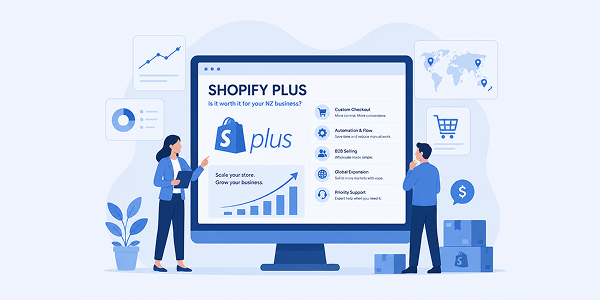
Shopify Plus is Shopify's enterprise tier, and it occupies an odd place in most NZ retailers' minds.
Read More


